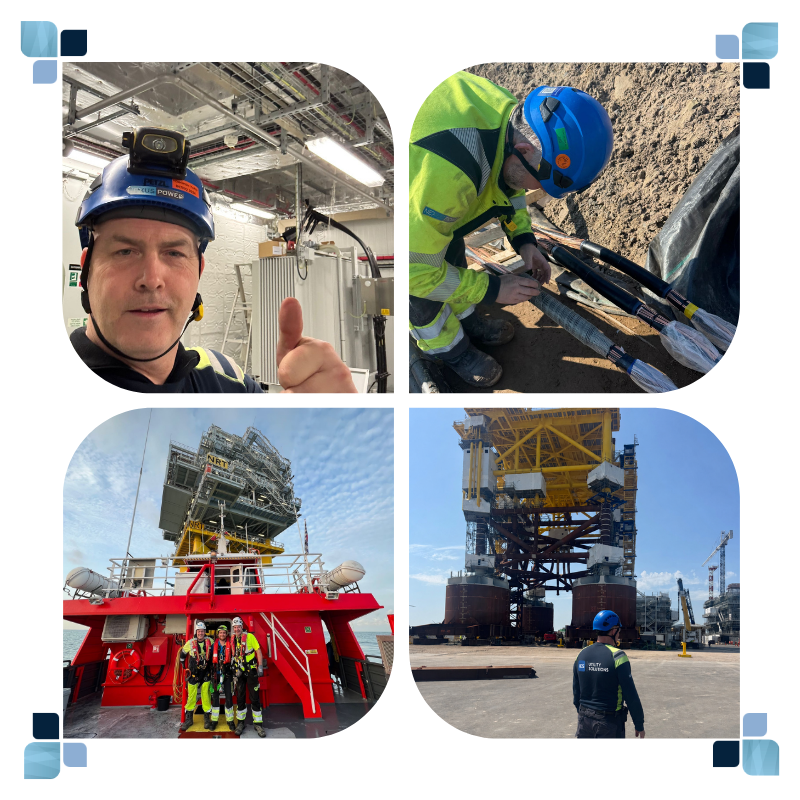
From remote coastlines to cutting-edge offshore substations, Brendan McNally’s career has taken him far beyond what he first imagined when studying civil engineering at Salford University. Now Brendan is Operations Director for UK and Europe at IES Utility Solutions. Brendan plays a pivotal role in delivering high-voltage (HV) and extra-high-voltage (EHV) projects mainly working across HV offshore projects on sites in Scotland, Holland and Ireland.
“I didn’t always know I’d end up in the power industry,” Brendan admits. “I actually wanted to be a firefighter. But I found my way into engineering, and what really hooked me was the variety. You get to see the world and be part of something meaningful.”
We caught up with Brendan to find out a little bit more about his role and some of his personal highlights over the years.
Brendan’s work is anything but routine. His role spans the full lifecycle of HV projects, from being involved in the planning and pricing through to the installation, testing and delivery. “Every aspect of the job comes through you at some point,” he explains. “Programming, jointing, purchasing — start to finish.”
On offshore projects, the day begins early and runs long. Crew transfer vessels (CTVs), helicopters, and jack-up vessels are all part of the commute.
“A typical day is a 12-hour shift — 7am to 7pm, or nights,” he says. “You might be heading out by boat or helicopter to an offshore substation platform or turbine. Every day is different depending on where you’re working.”
Despite the technical intensity of the role, it’s the lifestyle that can be one of the toughest challenges the teams face.
“The hardest part is being away from home and the long hours. You miss events, plans — things change quickly, and you have to adapt.”
Still, Brendan comes prepared to everyday. “My heated gilet is a must-have on site, it’s the best thing ever,” he laughs.
Working on HV and EHV systems demands absolute accuracy and technical discipline — something Brendan thrives on.
“If I had to describe the job in three words: precise, demanding, and interesting.”
Much of that precision comes down to the tools and technology used in the field. One standout piece of equipment has transformed how his teams operate:
“We use a Unipower peeling tool. It connects to a drill and strips the core insulation layer on XLPE cable. What used to be done by hand, now takes a fraction of the time — it’s a real game changer.”
Other innovations have helped reduce the physical strain of the job.
“Electric crimpers and hydraulic presses take a lot of the manual effort out of jointing. That makes a big difference when you’re working long hours.”
Digital tools have also reshaped the way teams collaborate offshore and across regions, making communication much easier. Sharing data, updates and test results in real-time.
Among the many projects Brendan has delivered, one recent highlight stands out:
“The Redmoss–Clayhills 132kV city cable project has been a big one — 18 double circuit joint bays, fibre splicing, four sets of terminations. We’re just coming into the final stage now, and it’s been a great achievement.”
Brendan has worked in some of the most unusual and challenging environments in the world — including Sakhalin Island in Russia.
“That was probably the most remote place I’ve ever worked. It took three days to get there from the UK. We were jointing cables for a gas processing plant, miles from anywhere.”
Closer to home, he enjoys large-scale collaborative projects, especially those involving offshore infrastructure.
“Working in Hoboken, Belgium, installing MV and HV cables on offshore platforms was a great experience. Big teams, complex builds — that’s when the job really comes together.”
His favourite projects? The most demanding ones. “I prefer working on the EHV projects — 132kV and 220kV. They require more precision and attention to detail. That’s what makes them interesting.”
 Working Offshore vs Onshore
Conditions offshore and onshore bring very different challenges. “Offshore, the weather can turn quickly, especially if you’re out on the OSS cable deck,” Brendan says. “But a lot of the time, you’re working inside turbines or switch rooms where it’s warm and controlled.”
However, Onshore wind farms can be tougher in many ways. “They can be cold, wet, exposed conditions. Offshore can actually be easier depending on where you’re stationed.”
They say that every day is a school day and that’s something that Brendan still firmly believes in. “I’ve learnt that you’re always learning. Despite all the years of experience, listening to your colleagues’ ideas and suggestions always have a positive outcome for the job.” That mindset has shaped his approach to leadership and teamwork, where collaboration is critical on complex HV installations.
For Brendan, the future of the industry is one of rapid transformation — and opportunity.
“What excites me most is the pace of change,” he says. “We’re seeing huge advancements in renewables — wind, solar, tidal — making energy cleaner and more accessible.”
He points to several key developments that will define the sector in years to come:
“It’s all moving in the right direction. The work we’re doing now is laying the foundations for a much more sustainable energy system.”
Brendan’s career has been shaped by simple but powerful principles.
“The best advice I’ve ever had is: you cannot rush perfection. That applies to everything we do in this industry.”
For those considering a career in engineering, his message is clear:
“Work somewhere you feel happy and valued — you won’t go wrong.”
From remote islands to offshore wind farms, Brendan McNally is helping build the infrastructure powering the energy transition. His story highlights not just the technical expertise behind high-voltage engineering, but the people, dedication, and innovation driving the industry forward.
To talk to our project management team:
 Call
Call Email
Email