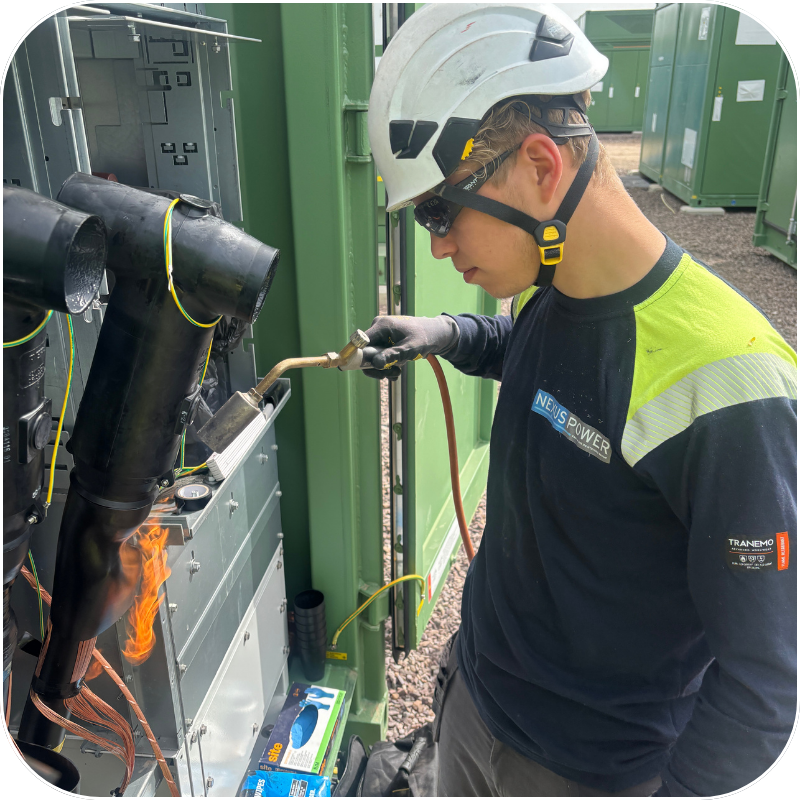
We recently caught up with one of our 33kV Cable Jointers, Harry Branthwaite, who is currently working on one of our projects at Hams Hall (BESS), to find out a bit more about what it’s like to be a cable jointer.
Over the past two years with IES, Harry has worked across the length and breadth of the UK, from the south-west coast of Scotland down to London. Travel plays a big part in the role and was one of the key factors that drew him into the industry.
“This job feels like there’s always something new to learn or try,” Harry explains. “From terminating cables to testing and commissioning, no two days are ever the same. Precision and teamwork are key, but it’s incredibly satisfying at the end of the day.”
With such a vast and interconnected power network, reliability is essential and that responsibility sits heavily on the quality of every installation.
“The network is huge, and everyone relies on it,” Harry says. “It’s imperative that installations and joints are done right to minimise any failures.”
At the core of the role is an understanding that every connection matters.
“Every joint and termination is a potential weak spot within the system, so it’s our job to install it like it isn’t there.”
Cable jointers play a vital role in connecting energy infrastructure, linking the grid to wind farms, both onshore and offshore, as well as maintaining underground connections. As the industry continues to evolve, the demand is growing, not just for new installations but also upgrading the existing systems to install newer more reliable ones to last longer.
At the moment, Harry is part of the team working at Hams Hall (BESS), delivering specialist 33kV cable installation, termination and testing works.
“A typical day at Hams Hall — there’s a lot going on,” he says. “We’ve got a full team on site testing cables, carrying out terminations, and making sure everything is completed to a high standard.”
The scale of the project adds another level of complexity. “The job involves hundreds of HV terminations from skid to skid, cable pulling into the switchroom, testing and phasing before termination, and then VLF testing after installation before energisation.”
It’s a fast-moving environment where attention to detail is constant and critical.
Precision is at the core of a cable jointer’s skillset, and consistency is non-negotiable.
“Every time you carry out a joint, you’ve got to double-check your work,” he explains. “Make sure nothing has been missed and that all your measurements are exactly right.”
Accuracy is one of the most critical factors in ensuring reliability. “All your measurements have to align with the manufacturer’s instructions and design. If they’re wrong, the layers won’t line up properly, and that can massively impact the termination.”
Different cable types also demand different approaches. “With XLPE, it’s all about cleanliness and accuracy — it’s a modern plastic cable. But with older PILC cables, your main focus is keeping moisture out. If water gets into that type of cable, it can cause serious damage.”
On large or complex projects, maintaining consistency becomes even more challenging. “It’s harder than people think,” Harry admits. “That’s why it’s important to have your team around you checking over your work — making sure everything meets the standards and manufacturer’s instructions.”
Moving across the different voltages there are different challenges and complexities that come with each of them.
“HV work is both physical and technical,” he explains. “You’re working with large cables — sometimes up to 800sqmm — bending them into tight spaces. It can be demanding.”
But EHV introduces an entirely new level of precision.
“It’s a much longer and more detailed process, with absolutely no room for errors. It takes a lot of time, dedication, and focus.”
The working environment itself also becomes more controlled.
“With EHV, you need a much larger, cleaner workspace where nothing can interfere with the process. It’s like you can’t take your eyes off the cable.”
Even the simplest tasks require more attention.
“There feels like an extra step in everything you do compared to lower voltages and the level of accuracy needed is on another level.”
While the technical skills are critical, Harry is quick to point out the personal qualities that make the biggest difference on site.
“One thing I didn’t expect when I started was how much my communication skills would develop,” he says. “You’ve got to be clear and vocal so everyone’s on the same page — that awareness across the team is crucial.”
For those considering a career as a cable jointer, the role requires a mix of mindset and practical skill.
“A lot of patience and precision is needed, and you need belief in what you’re doing because it can get very technical,” Harry explains. “But more than anything, it’s about teamwork.”
“This job is never something you do on your own. Being able to communicate and work closely with the people around you is key.”
To talk to our project management team:
 Call
Call Email
Email